Building a Simple Islamic Learning Routine for Children at Home
A home Islamic routine can become difficult when parents try to fit too much into it. Quran reading, memorization, Tajweed, Seerah, Fiqh, duas, and manners may all matter, but they do not need to appear in the same week.
Children usually need something simpler. A few short sessions, repeated regularly, are easier to maintain than a timetable that begins like a school schedule and is abandoned within a month.
Keep Quran Sessions Manageable
For a younger child, twenty focused minutes may be enough.
A session might begin with five minutes of revision, followed by ten minutes of new reading or memorization and a few minutes spent correcting pronunciation. An older child may manage longer, but there is little reason to stretch a lesson after concentration has gone.
Revision deserves its own place in the week. Children can easily move from one new surah or page to another without returning often enough to earlier work. Setting aside a session for material already studied prevents new work from constantly replacing old work.
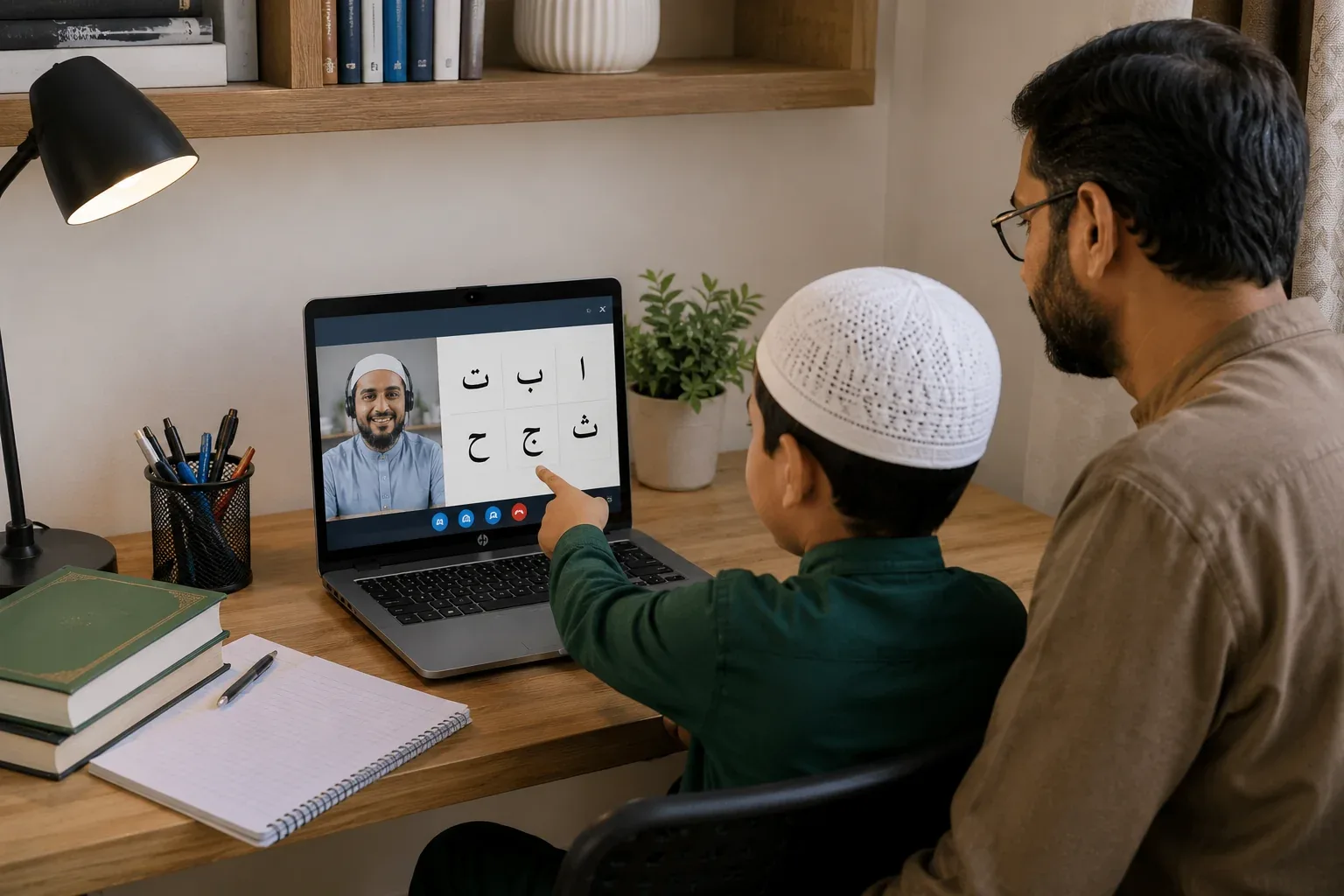
Parents also do not need to handle every technical part of Quran teaching themselves. A family might supervise revision during the week while usingQuran lessons for children for reading practice, Tajweed correction, or memorization with a teacher.
That leaves the parent with a practical job between lessons: make sure the child returns to the material instead of waiting for the next class.
Teach One Islamic Studies Subject at a Time
Islamic studies for kids covers more than one subject, so it helps to narrow the focus.
One month might centre on Seerah. Another could cover purification and salah. Older children may be ready to spend several weeks on introductory Aqeedah or basic Fiqh instead of moving rapidly between unrelated topics.
The lesson itself can stay simple. Read a short passage together, explain words the child does not understand, then ask what they remember or what confused them. A conversation often shows more about their understanding than asking them to repeat a paragraph.
A workable week might look like this:
Monday and Wednesday for Quran reading or memorization.
Friday for revision.
Saturday for a short Islamic studies lesson.
Families who prefer teacher-led study can includeonline Islamic studies lessons in that routine without turning the rest of the week into formal classes.
Bring the Lesson Into Ordinary Family Life
Some subjects make more sense when children see them outside lesson time.
If the current topic is salah, questions about prayer can continue when the family prepares to pray. During Ramadan, discussions about fasting, suhoor, and iftar already have a natural setting. There is no need to create a separate teaching moment every time.
Quran learning at home works in much the same way. A child who has memorized a short surah should continue returning to it during revision instead of treating memorisation as finished once the next surah begins.
Correction also needs some restraint. Interrupting every few seconds can turn a short Quran session into a frustrating exercise. Necessary mistakes should be corrected, but the child still needs enough uninterrupted reading to stay focused on the passage.
Leave Room for the Routine to Change
Some parents can teach most of the material themselves. Others prefer outside teachers, particularly for Quran recitation or subjects they do not feel prepared to teach. Families looking at live instruction may considerAl Quran Recitation Academy as one option for Quran and Islamic studies lessons for children.
The schedule should still fit the family rather than control it.
A seven-year-old learning to recognise words in the Mushaf does not need the same routine as a twelve-year-old studying Tajweed, memorising longer portions, and discussing Islamic studies in more detail.
Start with the amount the child can manage now. If three short sessions are working, there may be no need to add five. If a topic needs another week, give it another week.
A useful home routine is one the family can still follow after the novelty of making the timetable has worn off.